Guide to Building Performance Standard (BPS) Policies
Why multifamily owners are facing an increasingly complex compliance landscape.
Federal climate policy may be slowing—but at the local level, regulation is accelerating fast. Across the United States, states, counties, and cities are rolling out their own climate mandates for buildings. What began as simple energy benchmarking requirements has rapidly evolved into a new generation of policies known as Building Performance Standards (BPS), which not only require owners to report energy and water use but increasingly mandate measurable reductions in emissions and energy intensity.
The challenge for property owners is that there is no single rulebook. Each jurisdiction writes its own ordinance, with unique timelines, reporting formats, and performance targets. For owners managing large portfolios, especially across multiple cities or states, the result is a growing patchwork of compliance obligations. In some cases, a single building must navigate overlapping regulations. A property in Seattle, for example, may need to comply with both the city’s BEPS greenhouse gas intensity standards and Washington State’s Clean Buildings Performance Standard (CBPS), each with its own requirements and deadlines.
Where are BPS regulations in effect?
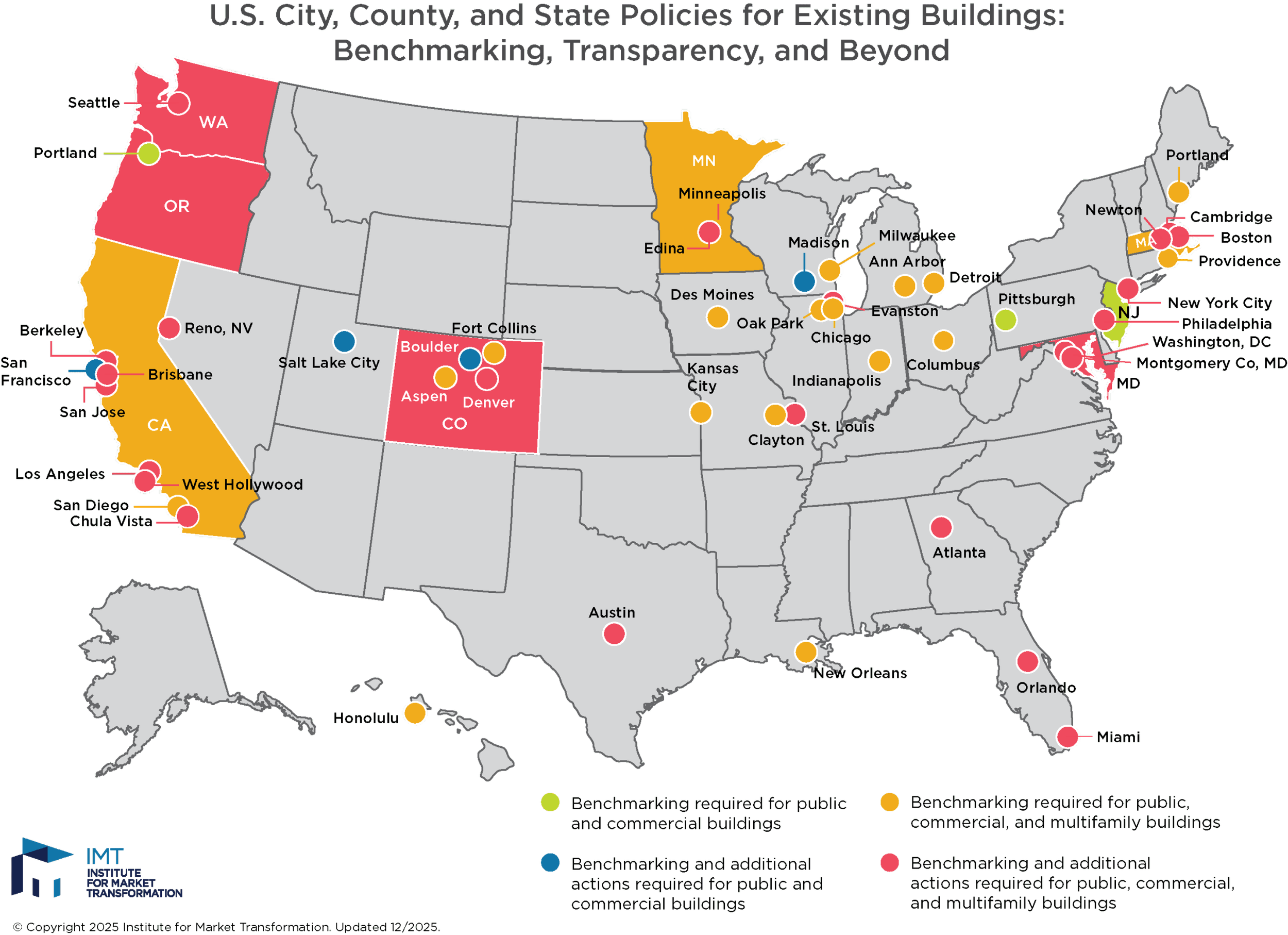
The National BPS Coalition consists of 46 jurisdictions that have committed to implementing BPS policies and programs into their jurisdictions.
There are currently 48 jurisdictions that require benchmarking for multifamily buildings, and 27 of those jurisdictions require additional actions.
Benchmarking vs BPS
Benchmarking requires owners to report a building’s annual energy—and sometimes water—use, typically through EPA’s ENERGY STAR Portfolio Manager (ESPM). While some jurisdictions require verification or retro-commissioning based on results, benchmarking itself does not require reducing consumption.
Building Performance Standards (BPS)—known by various local names such as Boston’s BERDO, Denver’s Energize Denver, or Washington, DC’s BEPS—go a step further. In addition to annual benchmarking, BPS programs require buildings to meet specific energy or emissions performance targets. Jurisdictions typically use one of three metrics:
ENERGY STAR Score
Weather-Normalized Site EUI
Greenhouse Gas Intensity (GHGI)
These metrics reflect total energy use, including electricity (grid and on-site renewable), natural gas, and steam. Most BPS policies establish increasingly stringent targets over time, with many aiming for net-zero levels by 2050.
How does BPS affect my property?
If your property is covered by a BPS, it must meet its prescribed performance targets or face fines that can add up to millions of dollars over the life of the building.
Take Seattle as an example:
Annual Reporting Fine: $2,000–$4,000 depending on square footage
Performance Fine (per 5-year cycle):
$2.50/sq ft for low-rent residential
$7.50/sq ft for multifamily
For a 250,000-sq-ft multifamily building, failure to report could cost $4,000 each year. Missing a performance target could result in a $1,875,000 fine every compliance cycle. For owners with multiple buildings or multi-cycle noncompliance, cumulative penalties can escalate quickly.
How do I know if my property is impacted and how do I avoid being fined?
With BPS policies emerging across the country—and many more in development—owners and operators face increasing complexity. Compliance typically requires full-building energy and water data, often collected and submitted through ENERGY STAR Portfolio Manager along with jurisdiction-specific verification steps.
Common challenges include:
Interpreting and tracking requirements across multiple jurisdictions
Collecting whole-building data and planning performance upgrades
Assessing potential fines and evaluating the ROI of energy-efficiency improvements
Although many deadlines may seem far off, early planning is critical. Understanding your buildings’ baseline performance, budgeting for upgrades, and implementing improvements all take time—delaying action increases both financial and operational risk.
Moving from Reactive Compliance to Portfolio-Level Control
As Building Performance Standards expand, multifamily operators must treat them as part of broader risk management and capital planning strategy.
Key questions every owner-operator should be able to answer:
Which assets are subject to BPS requirements today?
Which jurisdictions will activate requirements in the next 3–5 years?
How far is each asset from its required performance target?
What is the potential fine exposure range per building?
How should upgrade investments be prioritized across the portfolio?
Absent clear answers, compliance remains uncertain.
How GreenT Supports Multifamily Compliance Strategy
GreenT Climate Software provides an integrated platform designed to centralize and simplify BPS management across multifamily portfolios.
The platform supports:
Utility and ENERGY STAR data ingestion
Portfolio-wide benchmarkingBPS target tracking by jurisdiction
Fine exposure modeling
Regulatory requirement tracking
Compliance reporting workflows
By consolidating fragmented processes, owner-operators gain visibility into exposure, performance gaps, and enforcement timelines before penalties escalate.
Schedule a Portfolio Regulatory Risk Review
For multifamily operators in regulated markets, the most immediate priority is understanding portfolio exposure.
GreenT offers a focused Portfolio BPS Risk Review to help owner-operators:
Identify applicable jurisdictions
Estimate potential fine exposure
Highlight high-risk assets
Clarify upcoming compliance deadlines
Early clarity enables informed capital planning and reduces regulatory surprise. Schedule a Portfolio Regulatory Risk Review.